Ada Tech School
Long-term collaboration with a scale-up on the development of a Learning Management System
Founded in Paris in 2019, Ada Tech School (ATS) is an inclusive coding school. Based on an alternative learning method, it promotes active learning and soft skills in a non-stigmatising environment. We started working with them in 2021, initially to develop a Minimum Viable Product (MVP) for a Learning Management System (LMS). One year later, I was entrusted with the responsibilty for this project. This involved maintenance duties and developing the next iteration.
What was my role ?
Ensure flow of information
Plan and lead rituals
Cover product maintenance
Develop new features
Discovery
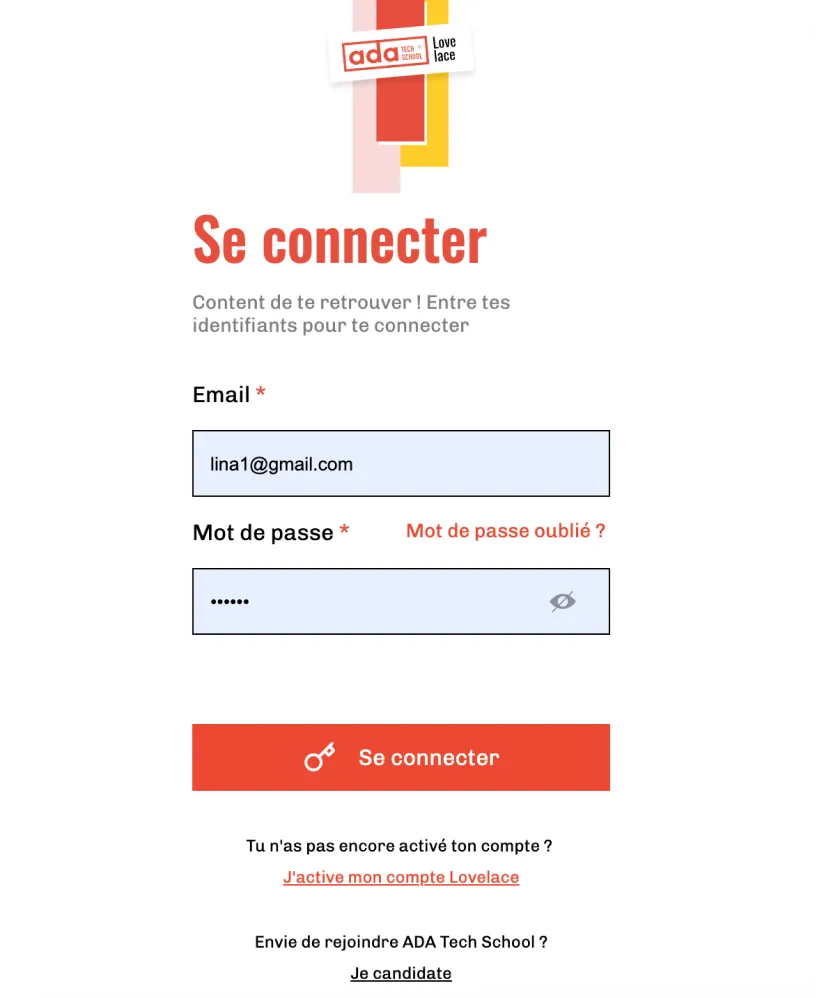
Overview of an MVP
The initial version of the web app was built by a previous team in my company. It needed to cater for different types of users: students, teachers and administrators. The latter two manage the back end, it was settup on Airtable because of its beginner friendly interface. The front end of the app is for the students, it was built on Weweb and it allowed them to log onto their account to access their schedule, course materials, take notes and validate skill badges.
Taking charges
A few months later, they got back in touch regarding the next version of the platform. I was put in charge of the project. In preparation for the next iteration, I defined the backlog for the sprint, estimated the time required, created a roadmap and edited the quotation.
Conception
During production periods, I followed the Agile methodology. We held daily meetings and weekly reviews to track the progress, and adjust the roadmap with the client.
Improve the user experience
The goal for the first upgrade was to complete the web app and centralise tools to improve the student experience, in four weeks. Three main functionalities were added:
- Students can set personal goals and assign them tasks in a daily to-do list.
- They can prepare for the end of quarter meeting with their tutor by completing a form on the app. Once the meeting is done, teachers can fill in their own form and decide when to display it and make it available for the student to download.
- We have integrated a new way to visualise their skill badges. Instead of a table view, they have access to a honeycomb-like board.

Include new types of sudents
This third iteration was directed toward the apprenticeship students. As they are mostly at work, the goal was to still make them feel integrated in the school. So, in addition to creating a new section to help them prepare their weekly meetings, we set up a booking tool that allows them to sign up for work slots at the school.
To help them to find an apprenticeship, we created a job board where students can access to partners job offers. We also added a Kanban board to help them organise their job hunt.
Constant improvement
To ensure a good experience using the web app, a support system was set up. If a user encounters a bug, they can report it to the Head of Product at ATS. He can then have a first look and fix it himself if he knows how to, or fill in a bug ticket. To optimise processing, I set up a simple template requiring several properties:
- Priority level (critical, blocking, normal, upgrade).
- Type of bug (graphic or functional).
- Intended action and the result.
- Screen type (mobile, tablet or computer).
- Screenshot.
To let the client track progress, each ticket had a status (to do, in progress, to review or done). This is a basic system but, as I was not full time on maintenance duty, it allowed us to save time on information transmission. If there was no critical bug, once a week I would spend a day or half of it handling the tickets. At the end of the day, I would report to the head of product at ATS on my process for finding the root causes of the bugs and how I dealt with them.
Solution
Taking a step-by-step approach while focusing on scalability and flexibility, allowed us to develop an all-in-one platform that meets the needs of the students while being easy for the school administrators and teachers to manage.
This continuous collaboration lasted over 3 years, during which Ada Tech School was able to raise three million euros, train more than 500 students and open two new campuses in France.